Causal Chain 001
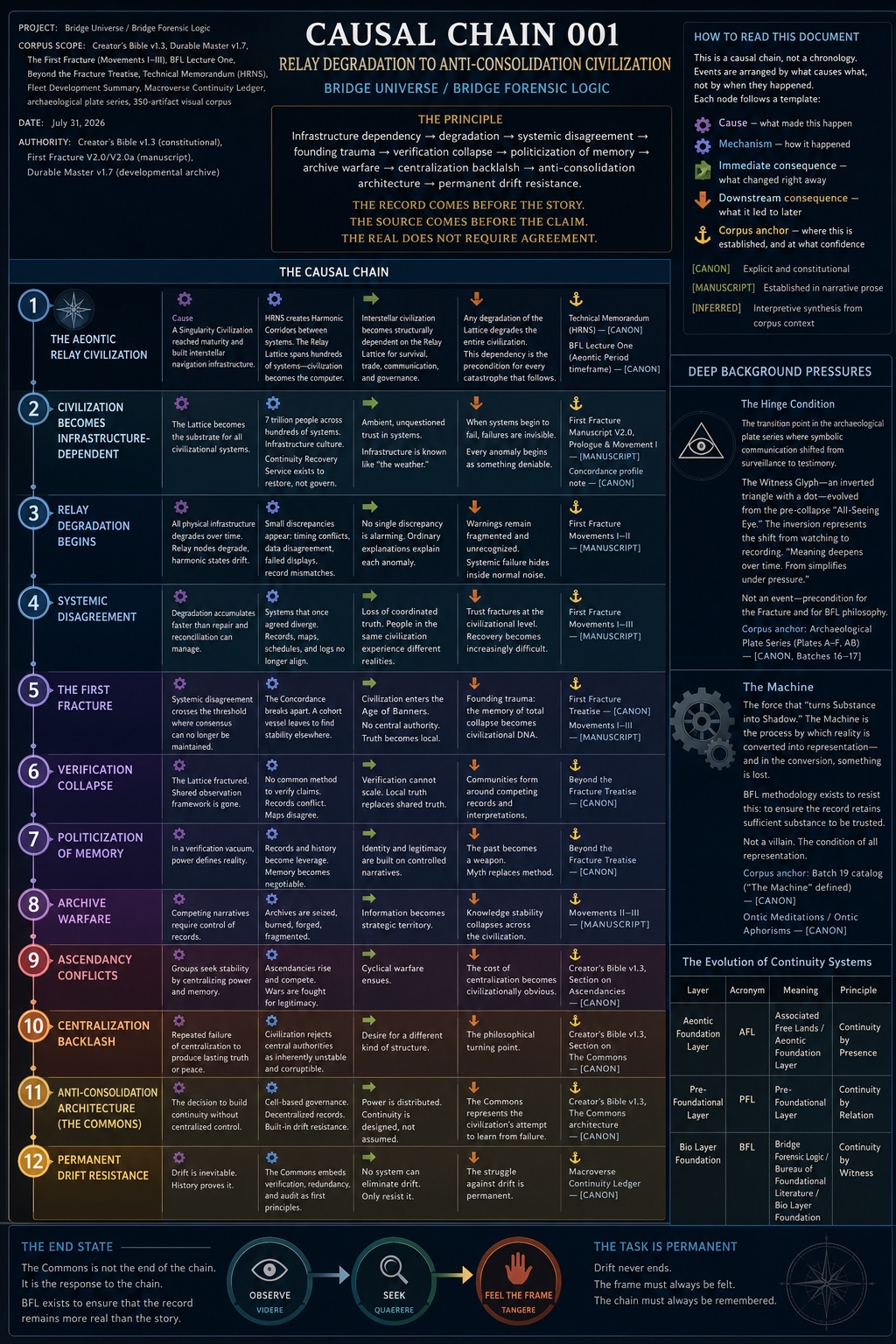
Relay Degradation to Anti-Consolidation Civilization. A timeline organized by causality rather than chronology — showing how events connect and what consequences follow from what.
How to Read This Document
This is a causal chain, not a chronology. Events are arranged by what causes what, not by when they happened. Where chronology matters, era references appear in brackets. Each node follows a template:
- Cause — what made this happen
- Mechanism — how it happened
- Immediate consequence — what changed right away
- Downstream consequence — what it led to later
- Corpus anchor — where this is established, and at what confidence
Links marked [INFERRED] are interpretive synthesis from corpus context. Links marked [CANON] are supported by explicit constitutional or manuscript text. Links marked [MANUSCRIPT] are established in narrative prose.
The Spine
The main causal chain traces nine nodes from the Aeontic relay civilization through to the standing threat of drift in the mature Commons.
The Aeontic Relay Civilization
A Singularity Civilization (~45,000–25,000 years before Convergence) reached sufficient technological maturity to encode interstellar navigation into physical infrastructure.
The Harmonic Relay Navigation System (HRNS) was built. Spacetime has an observable harmonic state. Navigation establishes resonance between two harmonic states to form a stable Harmonic Corridor. Transit takes measurable time — days to years. The Relay Lattice was constructed across hundreds of star systems, making "civilization itself the navigation computer."
Interstellar civilization becomes structurally dependent on relay infrastructure. Trade, communication, governance, and survival all route through the Lattice.
Any degradation of the Lattice degrades civilization itself — not a single service, but the connective tissue of the entire civilization. This dependency is the precondition for every catastrophe that follows.
Technical Memorandum (HRNS), 12pp — [CANON]. BFL Lecture One — [CANON].
Civilization Becomes Infrastructure-Dependent
The Relay Lattice was not built as one system among many. It became the substrate through which all other systems operated.
The Concordance grows to approximately 7 trillion people across several hundred star systems. The Brandestock-class vessel is 1 cubic kilometer — "a mobile infrastructure platform carrying portions of civilization itself." The Continuity Recovery Service: "Neither governs nor archives. It restores."
The civilization's mature, redundant infrastructure creates a condition where people know infrastructure "in the way that children know the weather." Trust in systems becomes ambient and unquestioned.
When systems begin to fail, the failure is not recognized as catastrophic because the ambient trust is too deep. "Every anomaly begins as something deniable."
First Fracture Manuscript V2.0, Prologue and Movement I — [MANUSCRIPT]. Concordance profile — [CANON].
Relay Degradation Begins
The Relay Lattice, like all physical infrastructure, is subject to degradation over time.
Degradation manifests first as small, individually deniable discrepancies. Advisory timings don't match across systems. Navigation data disagrees between instruments that should agree. Communications chime but fail to display. Attendance records disagree with the children physically present in the room.
No single discrepancy is alarming. Each one has an ordinary explanation. But the discrepancies accumulate, and they do not resolve.
The accumulation of individually deniable failures cascades into systemic disagreement. Independent realities cease agreeing. The shared record of what is happening fractures.
First Fracture Manuscript V2.0, Movement I — [MANUSCRIPT]. "relay degradation produces the First Fracture" — [CANON]. Editorial Constitution: "Every anomaly begins as something deniable" — [CANON].
The First Fracture
Relay degradation crosses a threshold where individual discrepancies can no longer be reconciled.
The Fracture is a cascade of institutional failures: communications behave inconsistently, transportation reports become contradictory, and the record-keeping systems begin to disagree with direct human observation. A collision occurs near a school. Emergency response arrives but communications degrade. The headmaster places the school under local authority: "act on direct observation."
The Fracture forces a choice between trusting systems and trusting observation. Direct human observation becomes the only reliable standard. The core doctrine emerges: "The record does not belong to power. It belongs to continuity."
This moment becomes the founding trauma of the Concordance. It is the event that proves the necessity of BFL methodology.
First Fracture Manuscript V2.0, Movement I, all six sections — [MANUSCRIPT]. First Fracture Editorial Constitution — [CANON].
Verification Collapse and the Politicization of Memory
The First Fracture damages the verification systems that made records trustworthy.
Era V. Verification collapses. Mythology contaminates history. The "Age of Banners" emerges: memory becomes political. Factions contest what happened and whose account is authoritative. The record becomes a battlefield.
The civilization discovers that destruction is not the primary threat to continuity. Erosion, drift, and administrative friction are.
Two permanent architectural decisions: the anti-consolidation principle (no single authority controls the record) and the witness doctrine (independent observation as constitutional obligation).
seven_eras.md, Era V — [CANON]. The Mandate of Witness — [CANON]. "Age of Banners" from master timeline — [CANON].
Archive-Targeting Conflicts
When memory becomes political, the infrastructure that preserves memory becomes a military target.
The Burning of the Third Archive Fleet. Armed conflict specifically targeting continuity infrastructure. Ships designed to carry portions of civilization's record are destroyed.
The civilization learns that continuity infrastructure is not collateral damage — it is the objective. Destroying the record is how you win a war about what happened.
Continuity preservation becomes defensive infrastructure: Particulate Veil, Null Signature Baffles, False Corridor Projectors, Archive Shatter Protocols. The Archive is a fortified system. Keepers are custodians under threat.
"The Burning of the Third Archive Fleet" — [CANON]. Stable Storm Operator — [CANON]. Addendum C — [CANON].
The Ascendancy Conflicts
Post-Convergence, factions attempt to seize centralized control of relay infrastructure. The memory of the Age of Banners creates an incentive to control the record.
Groups attempt to establish centralized relay authority. But the centralization attempt itself becomes the threat it was meant to solve.
Civilization nearly destroyed again. The attempt to secure the record through centralization replicates the conditions that made the First Fracture catastrophic — a single point of failure.
This trauma becomes the founding architectural principle: anti-consolidation. "No civilization worthy of continuity entrusts its future to a single point of failure."
ascendancy_conflicts.md — [CANON]. BFL Lecture One — [CANON]. CONCEPTS SUMMARY — [CANON].
The Concordance Adopts Anti-Consolidation Architecture
The accumulated trauma of the First Fracture, the Age of Banners, the Burning of the Archive Fleet, and the Ascendancy Conflicts produces a civilizational consensus: centralization is the enemy of continuity.
The 75% local sufficiency standard. The Quad Fleet distributes capability across four functional classes. Relay Custodians maintain infrastructure as a custodial trust. The Maker-Maintainer culture prevents the separation of knowledge from practice.
The Commons, Era VII — structurally resistant to the failures that preceded it. No single degradation can cascade systemically.
The Commons matures as a civilization of ~7 trillion people. Its institutions are thought experiments. Its professions are arguments. Its disasters are questions. The Bridge is "a function, not a hero."
Quad Fleet Canon — [CANON]. CONCEPTS SUMMARY — [CANON]. The Laboratory of Continuity — [CANON].
The Standing Threat: Drift and the Silent Harvest
Anti-consolidation architecture solves the problem of centralized failure. It does not solve the problem of slow erosion.
Drift is the process by which continuity corrupts over time when institutions lose their original function. The Silent Harvest: "Not a sudden theft; it is a slow, quiet erosion." It operates through administrative friction. Drift is "descriptive, not moral" — it happens to institutions the way entropy happens to systems.
The civilization requires permanent vigilance against drift. The Office of the Navigator Archivist monitors and reports drift. The system refuses to fake connectivity: "When a path exists, it is trustworthy. When the path is gone, the link does not pretend otherwise."
Drift and the Silent Harvest remain the standing threat of the mature Commons. They cannot be defeated, only resisted through continuous practice. "The Bridge is a function, not a hero — there is no final victory, only ongoing maintenance."
THE-SILENT-HARVEST.pdf — [CANON]. Drift canon rule — [CANON]. PLATE AB — [CANON].
Causal Summary
The Bridge Universe's causal architecture can be stated as a single argument:
Each node in this chain is both a consequence of the previous node and a cause of the next. But the chain is not linear — it is recursive. The anti-consolidation architecture of the Commons exists because of the Ascendancy Conflicts, which exist because of the politicization of memory, which exists because of the First Fracture, which exists because of relay degradation, which exists because of the infrastructure dependency that the Aeontic civilization built.
The Commons is a civilization that built itself in response to its own worst failures. Its architecture is not aspirational. It is scar tissue.
And the standing threat — drift, the Silent Harvest, the slow erosion — is the one enemy that architecture cannot defeat. It can only be resisted through continuous practice: witness, record, maintain, keep.
This causal chain is an analytical document, not a narrative. It organizes corpus material by causality for structural reference. Where causal links are inferred rather than directly stated, they are labeled [INFERRED] in the full document. All other links are anchored to specific corpus sources as noted.